NYC Health + Hospitals Unveils New Systemwide Collaborative Mural Created by Its Five Hospital-Based Violence Interruption Programs
The public health care system's first mural created through systemwide collaboration represents its Hospital-based Violence Interruption Programs' (HVIP) shared commitment to addressing violence and healing impacted communities HVIP programs utilize a three-pronged approach to treat victims of violence and ensure their lasting recovery: interruption, prevention, and community engagement
Jan 08, 2026
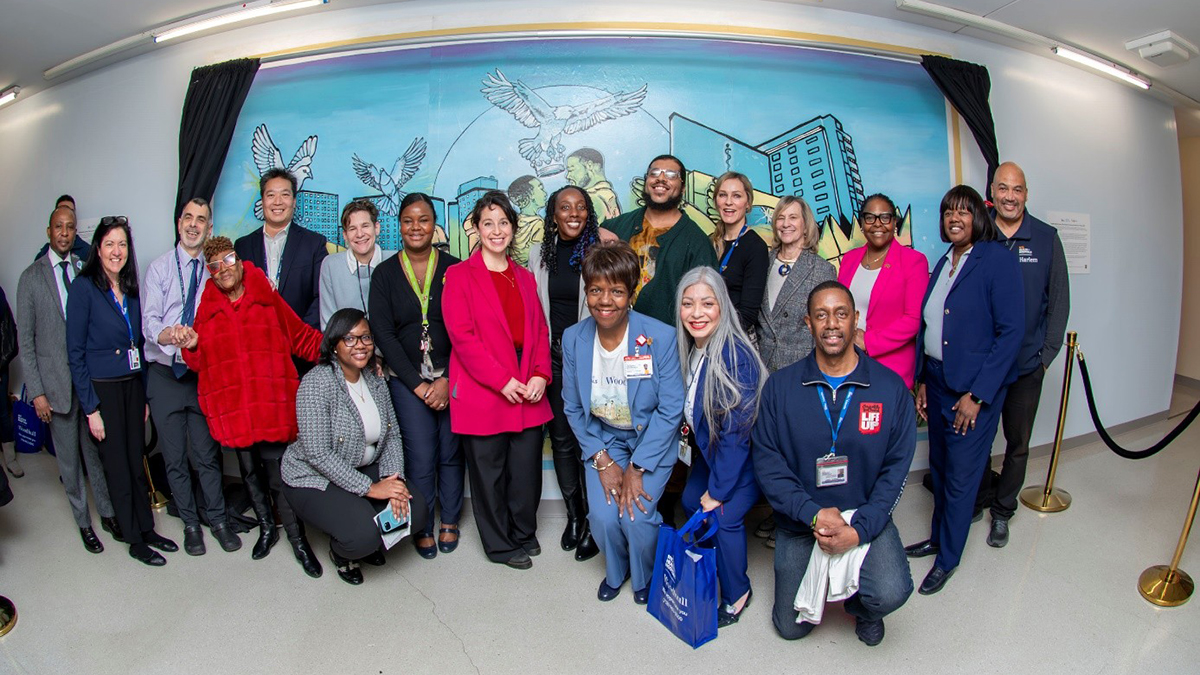
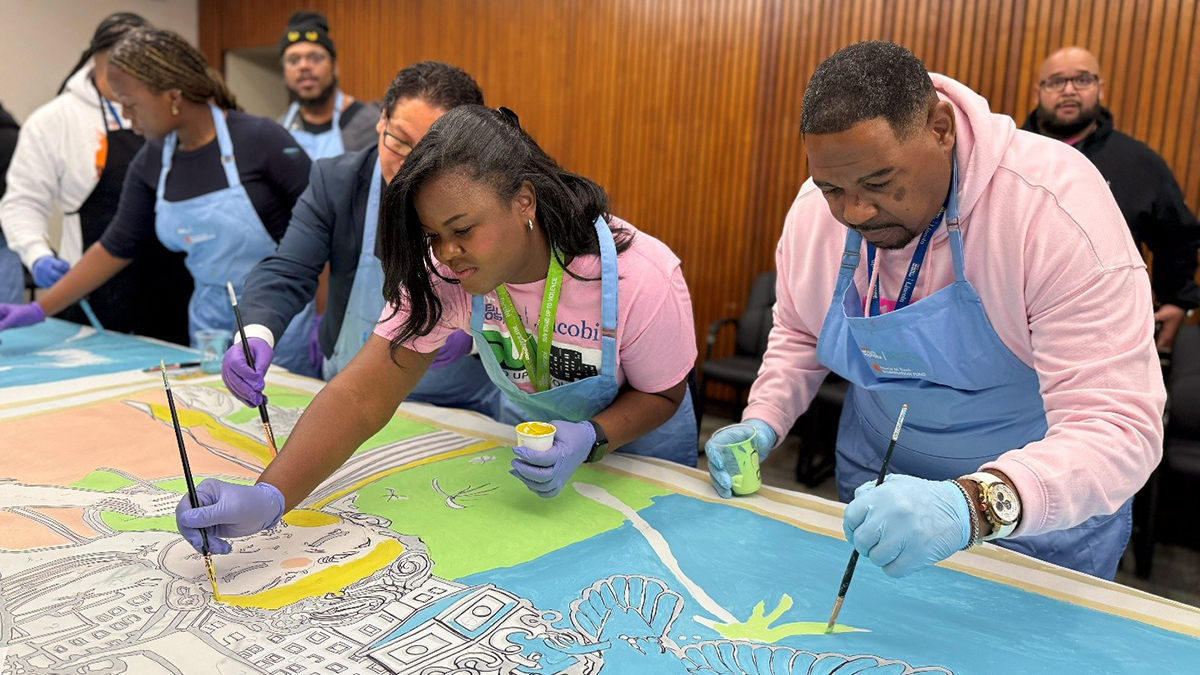
NYC Health + Hospitals today unveiled If We Dreamed: A Journey for Peace in Our Streets, a first-of-its-kind systemwide mural created in collaboration with its Hospital-based Violence Interruption Programs (HVIP) and Arts in Medicine department to represent the public health care system’s commitment to addressing violence and healing impacted communities. The mural — created by artists Shenna Vaughn and William Bentley of Vaughn Bentley Creative in collaboration with more than 75 youth participants and staff with HVIP programs at NYC Health + Hospitals/Harlem, Jacobi, Kings, Lincoln, and Woodhull — honors HVIP programs’ shared mission to break cycles of violence by providing interruption, prevention, and community engagement services that heal victims’ trauma and build safer, more peaceful communities. The original work will be displayed at Woodhull Hospital with replicas installed at Harlem, Jacobi, Kings, and Lincoln Hospitals. This latest installment of Arts in Medicine’s Community Mural Project — considered to be the largest public hospital mural program in the country — is the inaugural debut of a mural created through a systemwide collaboration. The first wave of the Community Mural Project is featured in the book Healing Walls: New York City Health + Hospitals Community Mural Project 2019-2021. This and other murals at NYC Health + Hospitals can be viewed on Bloomberg Connects. The Community Mural Project is made possible through the support of the Laurie M. Tisch Illumination Fund.
“At NYC Health + Hospitals, we recognize that violence is a public health epidemic that demands we work in unison across our hospitals to treat victims and support community healing,” said Dr. Mitchell Katz, President and CEO of NYC Health + Hospitals. “By bringing our five Hospital-based Violence Intervention Programs together in a shared creative process, we created a testament to our shared mission that will live in our hospitals as a source of connection, reflection, and hope for many years to come. This mural will provide our staff, our patients, and especially our young people a visible reminder that our hospitals are places not only for treatment, but for healing, belonging, and change.”
“Our youth are our greatest promise, and prevention begins by surrounding them with care, guidance, and opportunity,” said Sandra Sneed, Chief Executive Officer, NYC Health + Hospitals/Woodhull.“This mural reflects what is possible when hospitals, families, and community partners come together with a shared commitment to protect and uplift youth. At Woodhull Hospital, violence prevention is not only a public safety priority — it is a public health imperative. By investing in partnerships rooted in trust and compassion, we help create pathways where young people can thrive, dream boldly, and grow into their full potential.”
“The If We Dreamed mural reflects who we are as a system — united against violence, committed to healing, and strongest when we work together,” said NYC Health + Hospitals Assistant Vice President of Quality and Safety Marlee Ickowicz. “Seeing staff and participants from our five HVIP programs come together to design one mural illustrates how art can unite us, honor lived experiences, and serve as a force for healing and hope. Thank you to Arts in Medicine and the Laurie M. Tisch Illumination Fund for supporting our systemwide collaboration to help bring this vision to life.”
“This mural is a powerful testament to what becomes possible when art, healing, and community come together with a shared purpose,” said NYC Health + Hospitals Assistant Vice President of Arts in Medicine Larissa Trinder. “Through If We Dreamed, our youth, our artists, and our hospital-based violence interruption teams created not just an artwork, but a vision for hope, safety, and belonging. We are honored to help bring their voices to the walls of our hospitals, where this piece will continue to inspire connection, reflection, and the possibility of peace.”
“We are proud to have provided the early support that helped NYC Health + Hospitals establish its Arts in Medicine program and to help make this systemwide mural possible,” said Laurie Tisch, founder and president of the Laurie M. Tisch Illumination Fund. “Our mission aligns closely with Health + Hospitals’ commitment to equitable and compassionate care, and over the past seven years we have seen the impact of integrating the arts as a strategy to improve wellbeing. The Community Mural Project has demonstrated how collaborative artmaking can support healing, increase resilience, build trust, and foster community connections. If We Dreamed also elevates the voices of young people and reinforces the essential work being done across New York City to interrupt cycles of violence. We look forward to continuing our partnership and to building a healthier, more hopeful future for all New Yorkers.”
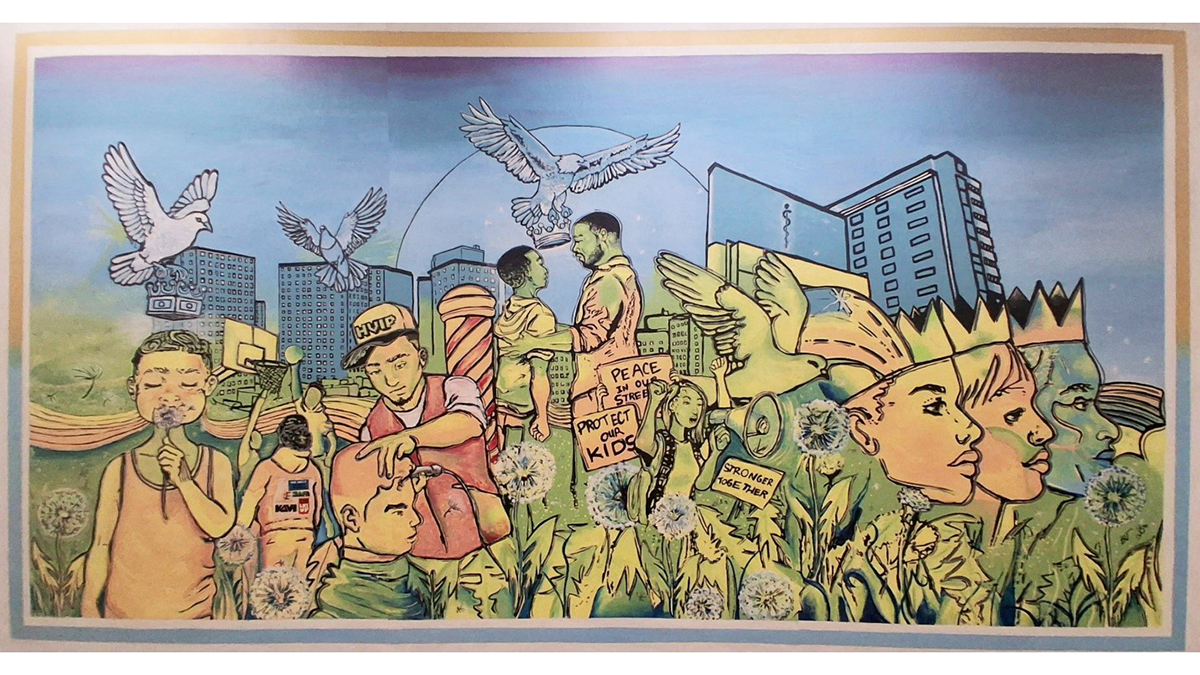
If We Dreamed: A Journey for Peace in Our Streets envisions a community grounded in peace, protection, and care. The mural portrays everyday moments of community life and activism — youth playing basketball, gathering at the barbershop, working through moments of tension, and advocating for their safety — to reflect the resilience, unity, and strength at the heart of neighborhoods across New York City.
The logos of each of NYC Health + Hospitals’ five HVIP programs — Harlem Crossroads at Harlem Hospital, Stand Up to Violence (SUV) at Jacobi Hospital, Kings Against Violence Initiative (KAVI) at Kings County Hospital, Guns Down Life Up (GDLU) at Lincoln Hospital, and WICK Against Violence (WAVI) at Woodhull Hospital — are woven throughout to affirm their vital role supporting young people and communities affected by violence. A hospital adorned with the rod of Asclepius anchors the scene, underscoring the public health care system’s role as a source of healing, wellness, and protection.
In the foreground, a child blows dandelion seeds into the air, each floating seed a symbol of hope, renewal, and the shared right to dream. Birds in flight — a dove, pigeon, and eagle — rise into the sky, evoking freedom, peace, and the vision of a safer future. The mural helps us see a world where youth live in confidence, harmony, and security and reminds us that when families, organizations, and neighbors come together, peace and opportunity form the foundation of community life.
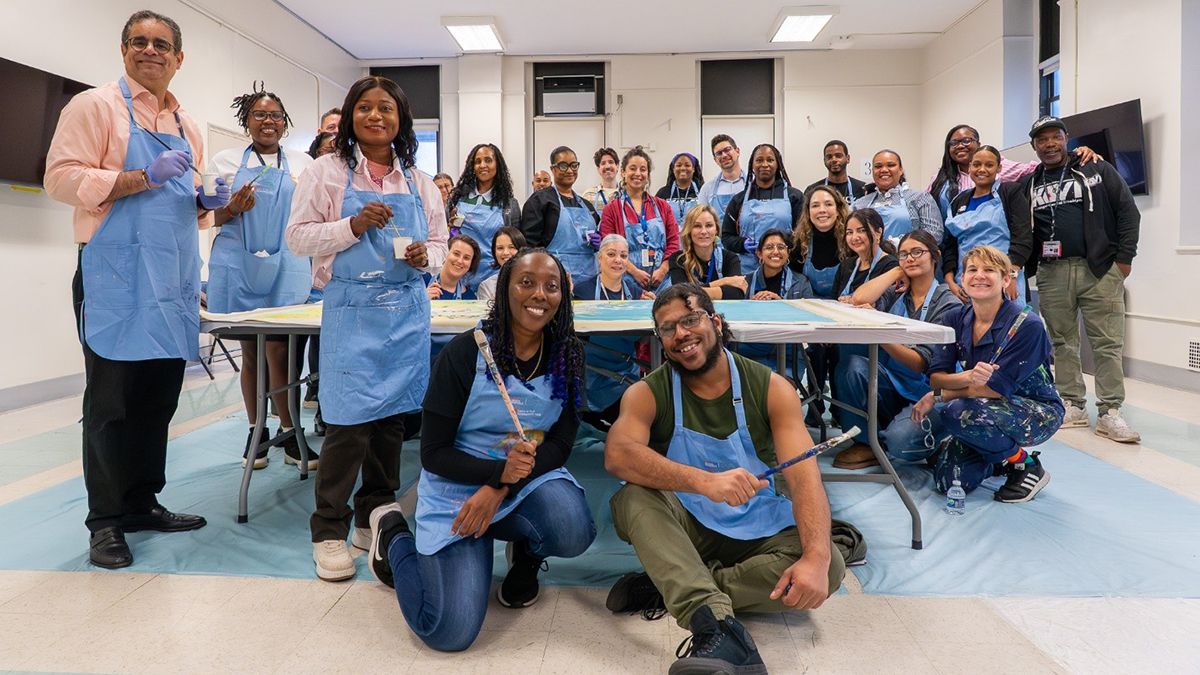
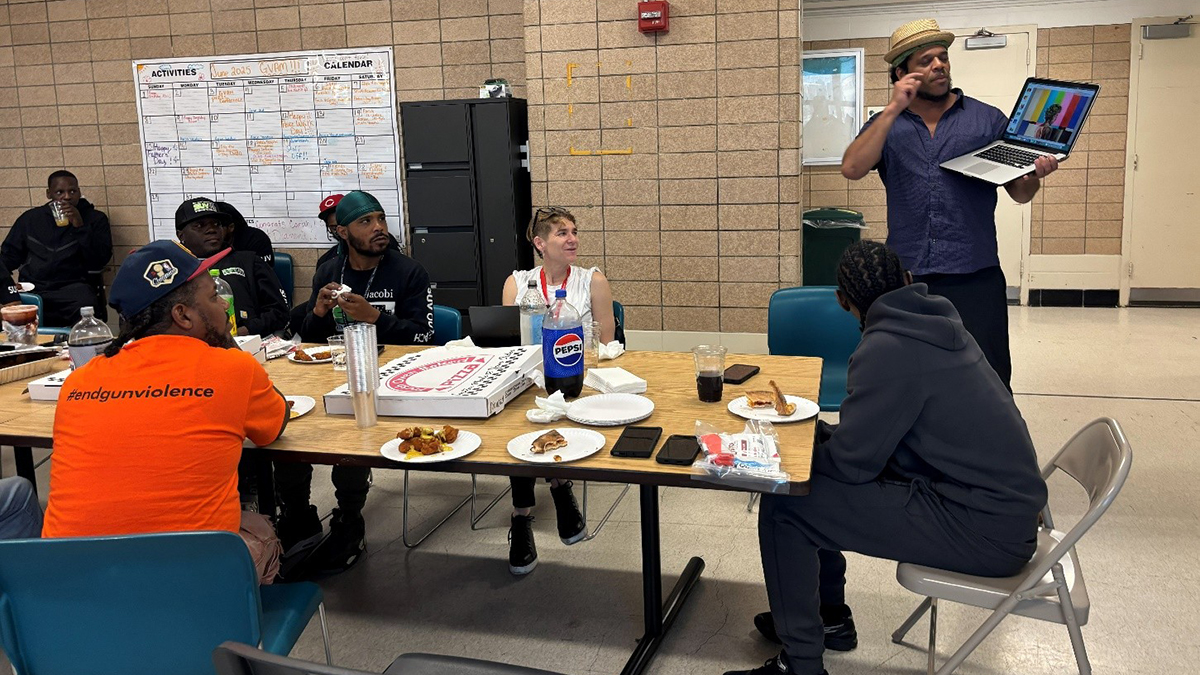
The creative collaboration the public health care system’s HVIP programs builds upon their recent systemwide unification and shared commitment to working together to address youth violence and help communities heal. Over the course of seven focus group discussions and five in-person art making sessions facilitated by the Arts in Medicine department and artists Shenna Vaughn and William Bentley, over 75 program staff and youth participants collectively brainstormed what ideas and symbols to include in the mural and brought it to life. By designing and painting the work together, HVIP programs strengthened their relationships, sparked conversations about opportunities and best practices to reduce violence, and created a lasting symbol of unity, hope, and healing for impacted staff, patients, and community members.
“If We Dreamed: A Journey for Peace in Our Streets envisions a future shaped by care, fellowship, and growth rather than conflict within our communities,” said artists Shenna Vaughn and William Bentley of Vaughn Bentley Creative. “The mural-making process — rooted in listening, presence, and shared intention — created a space for healing, trust-building, and collective imagination for Health + Hospitals staff, youth leaders, and community partners. By working with Arts in Medicine to unite the five programs across Harlem, Jacobi, Kings, Lincoln, and Woodhull, the mural affirms an interconnected ecosystem of care and honors the power of youth as visionaries capable of transforming dreams into lived realities. We extend our deepest gratitude to the grassroots organizations and partners who made this project possible, and to the Laurie M. Tisch Illumination Fund for their generous support and belief in the power of art as a public good.”
“Violence interruption is a crucial component of the care we provide to our community,” said NYC Health + Hospitals/Harlem Chief Executive Officer Georges H. Leconte, MPA, FAB. “We are proud to have a dedicated team at NYC Health + Hospitals/Harlem committed to offering resources and support to individuals of all ages. We look forward to the day when communities can maintain sustainable peace efforts and recognize the impact these initiatives have on all levels. If We Dreamed, beautifully depicts the strength and resilience of all communities, as well as the ability to make choices for the greater good of all. It serves as a powerful reminder that healing is a shared journey, one that we embark on together.”
“Artistic expression can give a voice to communities seeking to deliver a message, along with it being a powerful tool to help communities heal from the devastating impact of community violence,” said the Stand Up to Violence Team at NYC Health + Hospitals/Jacobi. “SUV was proud to participate in the NYC Heath + Hospitals HVIP mural project, as it was in line with our program’s universal belief that all members of our communities deserve to live in safe neighborhoods. At SUV, our work is both proactive- engaging high risk community participants before they are injured, and reactive- engaging violent trauma patients to prevent re-injury and retaliation. Our committed team of SUV outreach workers, social workers, physicians, and allied health care professionals work within the hospital and our communities to change the narrative of community violence. SUV’s participation in this mural project helps bring forth all of the good work being done in hospitals and communities to keep our neighborhoods safe.”
“This mural represents more than art — it reflects the healing, resilience, and collective commitment of the community to interrupt cycles of violence and support survivors on their path to recovery,” said James Peele, Kings Against Violence Initiative (KAVI) Program Manager at NYC Health + Hospital/Kings County. “Through Hospital Violence Intervention Programs, we are transforming moments of crisis into opportunities for hope, safety, and long-term change.”
“At Guns Down Life Up and our other HVIP programs, we give young people the tools and support to turn their lives around,” said James Dobbins, NYC Health + Hospitals HVIP Community Initiative Director and Executive Director of Guns Down Life Up (GDLU).“ Our work is not just about interrupting violence — it’s about showing youth that they have opportunities to create, dream, and be part of something bigger than themselves. Partnering with other HVIP programs, we’re using arts and culture to help young people see their worth and connect with positive paths. This mural is a reminder to those healing from violence that we have their back and that we’re all in this together, working towards a better future for our communities.”
“In collaboration with WICK Against Violence, we are proud to unveil the system’s largest HVIP community mural, installed in Woodhull’s main corridor so its message of peace reaches every patient, visitor, and staff member,” said Jessica Arocho, Director of Community Affairs and HVIP Program Coordinator, NYC Health + Hospitals/Woodhull. “Honoring our five HVIP sites, this piece stands as a unified symbol of our commitment to healing and a reminder to our community that they are never alone on the path to recovery.”
The city’s public health system recognizes that violence should be treated like any other communicable disease, and has developed its HVIP programming in order to diagnose and treat it. The three-pronged approach to treating violence — interruption, prevention, and community engagement — seeks to break cycles of violent trauma and provide victims and their communities the support they need for a lasting recovery.
Interruption begins at victims’ bedsides, during their most vulnerable moments and when they are often most receptive to change. Early interruption is critically important to breaking cycles of violence, preventing retaliatory violence by defusing conflicts and working towards mediation. The HVIP hospital teams are led by multi-disciplinary teams of physicians, nurses, social workers and violence interruption experts who provide a continuum of care to mediate conflicts, prevent retaliation, and reduce the risk of recidivism. This immediate support helps victims of violence and their loved ones find pathways to recovery and rehabilitation and connect to supportive services including Victim Crime Services, which support victim relocation and funerary services.
After providing immediate interruption, HVIP programs turn their focus to long-term, forward-looking prevention. HVIPs offer positive alternatives through hospital-community partnerships that provide youth opportunities to avoid problem behavior or violent incidents. These opportunities include school-based programming to strengthen youth skills and promote non-violent education, peer mentoring and after-school programming to connect youth to caring adults and activities, and year-round job and internship programs that prepare young people for and connect them to full-time employment.
Finally, HVIP programs ensure the communities they serve are engaged and mobilized to mediate conflicts and support at-risk youth. Through regular, grass roots outreach and the organization of community events, including vigils, marches, and health education workshops, in coordination with community stakeholders, HVIPs develop relationships with young people, foster community solidarity, and create positive, peaceful social norms.
“Now more than ever, New Yorkers are looking for sources of inspiration,” said New York Senator Kirsten Gillibrand. “Not only is NYC Health + Hospitals providing quality health care for anyone who needs it, but public art like this can and should make everyone feel welcome.”
“Our youth are our greatest promise, and violence prevention begins by surrounding them with care, guidance, and opportunity,” said Congresswoman Nydia M. Velazquez (New York’s 7th Congressional District). “That’s why I remain committed to securing federal funding for essential anti-violence initiatives like the WICK program and the Hospital-based Violence Intervention Program at Woodhull Hospital. These initiatives save lives and help young people thrive, dream boldly, and reach their full potential, while reinforcing that violence prevention is a critical public health priority.”
“We cannot address and prevent violence without acknowledging that it’s a public health issue, one that stems from structural inequities, unmet community needs, and untreated mental health conditions,” said Brooklyn Borough President Antonio Reynoso. “Hospital-based Violence Interruption Programs recognize this reality and connect survivors to a network of resources that don’t just heal individuals, but strengthen entire communities. I commend NYC Health + Hospitals for their commitment to breaking cycles of violence. This mural is a testament to that commitment and a powerful reminder of what our communities can look like when we invest in healing.”
“The Hospital-based Violence Interruption Program provides life-saving care by meeting people when it matters most,” said NYC Council Member Chi Ossé(Council District 36). “NYC Health + Hospitals is a national leader in this work, transforming moments of violence into opportunities for recovery. It meets people after violent injury with housing support, mental health care, and trusted community, especially in Black neighborhoods long denied investment and care. This is the model we should be expanding. I’m proud to support this work and the Hospital Violence Interruption Mural, honoring the people who show up every day to make healing and prevention possible.”
“Hospital-based violence intervention programs save lives by treating violence as a public health issue, not just a criminal one,” said New York City Council Member Jennifer Gutiérrez (Council District 34). “When hospitals partner with community-based organizations to support survivors in moments of crisis, we create real pathways to healing. This mural reflects the power of prevention, care, and community coming together.”
“The cycle of violence is vicious, but we can break it by intervening,” said New York State Senator Julia Salazar (18th Senate District). “That’s especially true in the immediate aftermath of violent injury, when those affected face a crossroads between escalation and healing. The Hospital-Based Violence Intervention Program offers resources necessary for healing, and I’m so appreciative that the program is at work right here in North Brooklyn. Preventing violence is not only deeply personal, but also a matter of public health. It concerns us all, as this mural so evocatively reminds us.”
“Often in life, we are subject to a cycle of violence,” said New York State Assemblywoman Maritza Davila, Chair of the Assembly Committee of Social Services (Assembly District 53). “We see it within our home lives, our communities, and even within ourselves. Yet, it is just as important to understand these cycles and why they are created, as it is to bring these cycles of violence to light. To show those affected that there is another way and with change we can bring hope to our community and to ourselves. That is why the hospital-based violence intervention program is imperative in communities that are unfortunately subjected to these cycles. With programs like these, and continued funding, we have a chance to change a narrative that has often been placed onto communities of color.”
“This mural stands as a powerful declaration that violence prevention is about care, connection, and community responsibility,” said New York State Assemblymember Stefani Zinerman (Assembly District 56). “It reflects our commitment to interrupting cycles of harm at moments of greatest vulnerability through compassion, prevention, and sustained investment in our youth and families. This partnership with Woodhull allows all of us to show up with care and purpose.”
###
MEDIA CONTACT: Press Office
#04-26
About NYC Health + Hospitals
NYC Health + Hospitals is the largest public health care system in the nation serving more than a million New Yorkers annually in more than 70 patient care locations across the city’s five boroughs. A robust network of outpatient, neighborhood-based primary and specialty care centers anchors care coordination with the system’s trauma centers, nursing homes, post-acute care centers, home care agency, and MetroPlus health plan—all supported by 11 essential hospitals. Its diverse workforce of more than 43,000 employees is uniquely focused on empowering New Yorkers, without exception, to live the healthiest life possible. For more information, visit www.nychealthandhospitals.org and stay connected on Facebook, Twitter, Instagram and LinkedIn.
About NYC Health + Hospitals/Woodhull
NYC Health + Hospitals/Woodhull, part of the NYC Health + Hospitals health care system, is the major tertiary care provider in the borough of Brooklyn. It is a premiere health care organization for key specialties, including surgery, women’s health, pediatrics, rehabilitation medicine, renal services, ambulatory care/primary care, emergency medicine, and behavioral health services. Last year, the hospital received close to 480,000 ambulatory care visits and close to 100,000 emergency room visits. For more information, visit www.nychealthandhospitals.org/woodhull, and stay connected on Facebook.
About NYC Health + Hospitals’ Arts in Medicine Department
The Arts in Medicine department at NYC Health + Hospitals seeks to foster the emotional well-being and promote healing and wellness for all patients and their families, employees, and the greater community by utilizing the arts, including literary, visual, and performing arts throughout the health care system. In addition to managing the system’s significant visual arts collection, the Arts in Medicine department encourages evidenced based practices and provides technical assistance to all of the system’s health care facilities and clinics. This is accomplished by combining artistic innovation and education into a comprehensive health care continuum that supports the healing benefits of the arts. For more information, visit www.nychealthandhospitals.org/artsinmedicine
About the Laurie M. Tisch Illumination Fund
The Laurie M. Tisch Illumination Fund is a New York City-based foundation that aims to improve access and opportunity for all New Yorkers and foster healthy and vibrant communities. In 2018, the Illumination Fund launched Arts in Health, a multi-year initiative to support organizations utilizing the arts as a tool for healing and building understanding in communities across New York City. The initiative’s areas of focus are stigma, trauma and aging-related diseases as well as supporting organizations addressing mental health in communities disproportionately affected by the Covid-19 pandemic. In 2019 the Illumination Fund supported the creation of NYC Health + Hospitals Arts in Medicine department, expanding programs serving health care staff, patients, and communities in sites across the City. For more information, visit www.lmtif.org or follow @LMTischFund on Twitter.
About Vaughn Bentley Creative
Vaughn Bentley Creative is a beacon of empowerment, healing, and artistic innovation, driven by a deep belief in the transformative power of art. Founded by artists who grew up facing adversity, the organization serves as both a platform for emerging talent and a sanctuary for creative expression, particularly within underserved communities. The founders of Vaughn Bentley, is a partnership of two NYC born artists, Shenna Vaughn and William Bentley. They found solace and healing in art during their childhood, a time when they felt misunderstood and unheard. Creating visual art became their escape from struggle, and a personal magic, offering a way to express themselves with a variety of graphic mediums. Through this journey, they discovered that art wasn’t just a form of expression; it was a source of communication, empowerment, healing, and hope.